
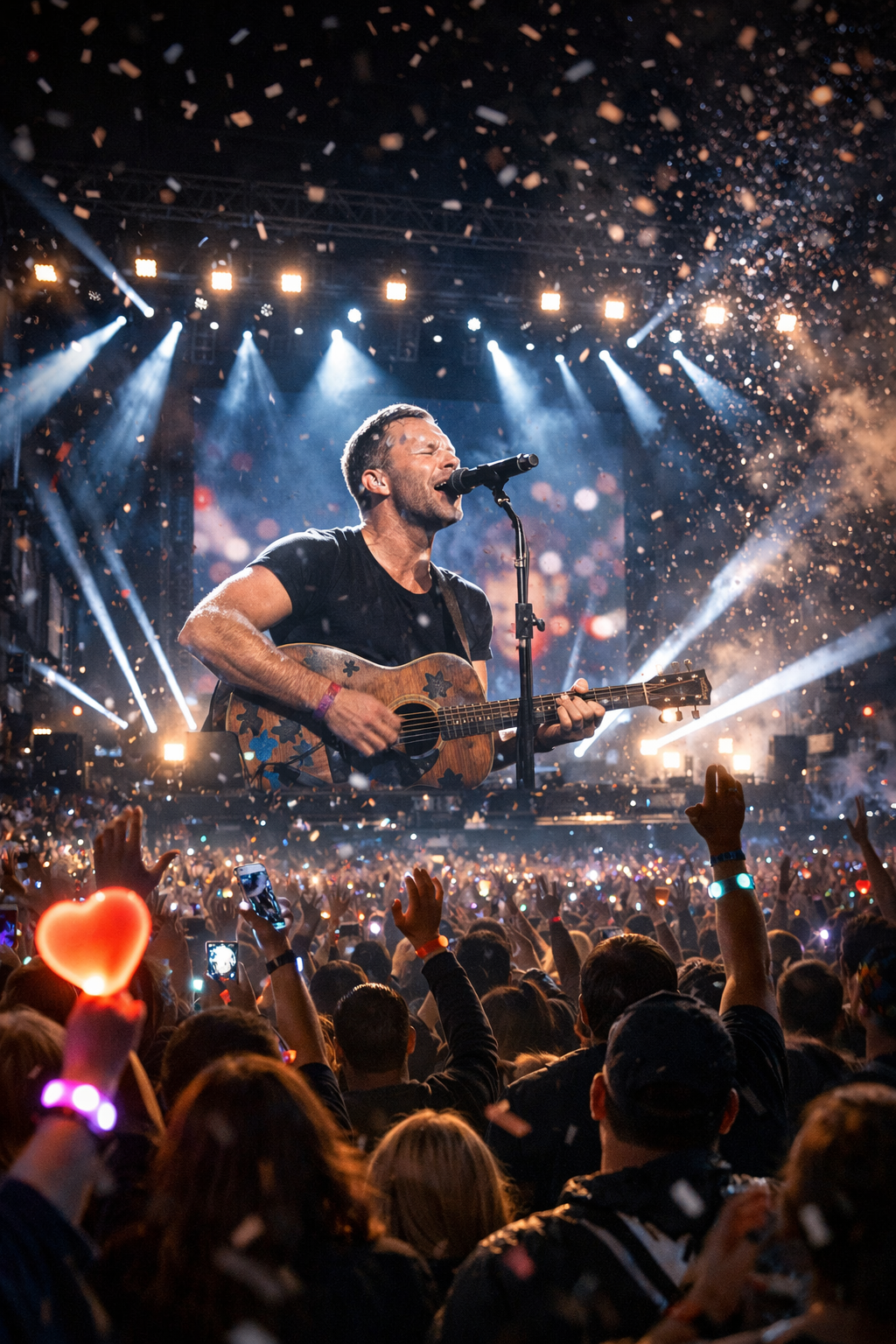
The lights at Wembley Stadium dimmed to a single spotlight.
Chris Martin stepped forward alone, barefoot, wearing a plain white T-shirt and jeans—the same simplicity he wore when he first demoed the song in a tiny London flat nine years earlier. The band stayed silent at the back of the stage. No one knew what was coming.
He took a long breath, looked out at the sea of 90,000 faces (though it felt like 25,000 were breathing with him in that moment), and said quietly:
“I wrote this in 2016. I recorded it alone one night when I couldn’t sleep. Then I listened back once… and I hid it. I wasn’t ready to say it. I didn’t think anyone else needed to hear it. But over the years I kept coming back to it. Tonight feels like the right time. So here it is.”
A soft, trembling piano line began—sparse, almost fragile. Then Chris started to sing.
The song—now called “Still Here”—is a hushed, devastating meditation on grief, guilt, the fear of being truly seen, and the quiet decision to keep going anyway. The opening lines landed like a confession:
“I smiled through the interviews while the house was on fire Told the world I was okay while I was burning alive Kept your name in my throat like a stone I couldn’t cry Pretended I was flying when I was learning how to die”
By the first chorus the entire stadium had become part of the arrangement. Twenty-five thousand voices joined—not shouting, but singing—softly at first, then stronger, as if they recognised every word even though they’d never heard it before. Phones rose like thousands of tiny lanterns. Tears streamed openly down faces in every section.
The second verse grew rawer:
“I carried your absence like a child I couldn’t save Wrote every happy song to keep you in the grave I’m still here breaking open in the light you couldn’t take Still here, still hurting, still learning how to stay”
When the final note faded, silence held for almost ten seconds—an eternity in a stadium that size—before the roar arrived. Not the usual stadium explosion. Something deeper. Grateful. Wounded. Healed, just a little.
Chris stood motionless, eyes closed, tears shining under the lights. He whispered “Thank you” into the mic, barely audible, then walked offstage without another word. The band never played another note that night. The show ended there.
Hours later the live recording was quietly uploaded to streaming platforms—no announcement, no artwork, just the audio titled “Still Here (Live at Wembley 2025)”. Within 24 hours it became the fastest-rising track of Coldplay’s career. Fans began sharing stories in the comments: losses of parents, siblings, partners, friends. The song didn’t explain their pain—it simply sat with it.
In a rare follow-up interview with BBC Radio 1 a week later, Chris said:
“I protected that song because I thought the truth in it was too heavy. Turns out the world had grown heavy enough to hold it with me. Hearing everyone sing it back… that was the moment I finally stopped hiding.”
Some songs are not forgotten. They are guarded. Kept in the dark until the light is strong enough to receive them.
On a summer night in 2025, 25,000 voices proved the world was finally ready.
